Research Updates for Midwives 2012 by Gail Hart also has an interesting chapter on routines, where she asks right at the beginning: “Why do we do what we do?”
Some modern birth practices are based on routines rather than observation and research. Some things are done the same way every time simply because that’s how they’ve always been done. So we do them routinely, but we can’t really say why. To do our work as well as possible, we need to start “routinely examining our routines” to make sure they are useful, effective, and safe.
“Routine birth” usually means a birth that takes place in a noisy, bright, small room—the delivery room. Routinely, the baby’s airways are suctioned immediately after birth, the umbilical cord is cut before it stops pulsating, there is no skin-to-skin contact and no sacred hour, the baby is washed with shampoo and/or oiled and dressed…
Transition after birth—the move to life outside the womb—is a PROCESS
After birth, mother and baby form a “unit”. That’s why, for emotional and physiological reasons, we need to give them enough time after birth to adjust, when separation is necessary. After many long months in the womb, where everything was fully provided via the placenta, the baby didn’t need to breathe with their lungs, etc., the baby is forced into major changes after birth. When placental support is interrupted, the heart redirects a much larger share of blood to the lungs and kidneys. At first, the baby’s lungs are filled with fluid, but within a minute after birth the fluid is squeezed out of the lungs into the circulatory system and the lungs are almost clear and can fill with air. This complex process is not instantaneous. The transition to life outside the womb takes time for the baby to fully adapt. We can influence this process.
Fetal blood circulation (source):

“Fresh (oxygenated) blood flows from the placenta through the umbilical vein to the fetus. This is the only blood in the fetus that is NOT mixed. Part of this blood flows directly into the inferior vena cava and mixes there with used (deoxygenated) blood coming from the lower part of the fetus’s body. Another, smaller part of this oxygenated blood flows from the umbilical vein into the liver and from there through the hepatic veins into the inferior vena cava. Both the superior and inferior vena cava empty into the right atrium. A smaller portion of blood flows from there through the tricuspid valve into the right ventricle. The remaining blood from the right atrium flows through the foramen ovale into the left atrium and then through the mitral valve into the left ventricle. Blood in the right ventricle is also divided. Part flows through the pulmonary valve into the lungs. The larger amount flows through the ductus arteriosus (Botallo’s duct), which connects the pulmonary artery and the aorta, into the descending aorta and the lower part of the body. Blood that has entered the left atrium flows through the mitral valve into the left ventricle and from there into the ascending aorta, which supplies the head and upper body. Once the blood is used there, part returns to the vena cava and through it back to the heart. The remaining blood flows through the abdominal arteries into the umbilical artery and back to the placenta, where it releases carbon dioxide and other metabolites.” Source and more
How a healthy newborn “behaves” in the first half hour after birth: the baby is active, the heart beats fast, they may have some breathing difficulties, there may be amniotic fluid in the mouth, body temperature drops slightly, their color changes—they may be bluish at first and then become pink..
Gail highlights a few routines that (un)knowingly affect a newborn’s adaptation
- Routine stimulation of the newborn—gentleness matters
We need to handle a newly born baby gently to help them adapt better to life outside the womb. Rough handling and quick movements can “shock” the newborn and may make them cry before all the fluid has been squeezed out of the lungs. Stimulating crying before the physiological “squeeze” of the lungs can cause uneven lung inflation, which can lead to respiratory distress or transient tachypnea.
After birth, place the baby in the mother’s arms and observe them to avoid unnecessary stimulation. The newborn should not be touched, handled, tickled, or rubbed, but should simply be in the mother’s arms—and if any stimulation is needed, it should ideally be done by the mother, if she wants that. Ideally, the room would have dimmed lights, and everyone present would try to speak quietly so the newborn can hear only the voices of the mother, father, and/or other family members.

Dry towels or diapers should be gently placed over the newborn and mother to absorb moisture. Rubbing the newborn to dry them is not necessary. If the baby is placed in direct skin-to-skin contact, there’s no need to dry them beforehand at all.
A healthy newborn will “clear” their lungs and take a breath within 30 seconds. They may also cry within the first minute. Some won’t cry even if their breathing is completely fine, so there’s no need for them to cry.
If the umbilical cord hasn’t been cut yet, the baby can transition to breathing with the lungs safely for a few minutes. It’s normal for a newborn to be bluish after birth, and their color quickly improves to pink. It starts on the chest; hands and feet may remain bluish for up to a few days. The newborn should have normal muscle tone, responsiveness, color, heart rate, and breathing throughout this time (Apgar assessment). They should respond to their surroundings and learn to breathe with their lungs.
If the baby is floppy and pale or shows any signs of asphyxia, they need help! Such a baby may need their airways suctioned, breathing stimulated, or resuscitation. Otherwise, the baby needs a gentle transition to life outside the womb.
2. Airway suctioning when the head is delivered
This became routine sometime in the mid-1970s to prevent aspiration of amniotic fluid in all births—at home, in hospitals, and in birth centers. This teaching was based on the theory that every newborn must be suctioned before the first breath to prevent choking on mucus or aspiration of meconium-stained amniotic fluid into the lungs. If we do this for every newborn, we will reduce respiratory distress syndrome (RDS) and meconium aspiration syndrome (MAS).

A few years of practice showed that the rate of meconium aspiration did not decrease, despite routine suctioning of all newborns. In the early 1980s, researchers began to question this method, but it was already deeply embedded in routine birth practices.
A large multicenter prospective randomized controlled trial including 2,094 babies born with meconium-stained amniotic fluid showed no reduction in MAS when airways were suctioned immediately after the head was delivered compared with no suctioning. (Lancet. 2004 Aug 14-20; 364 (9434):597-602; Oropharyngeal and nasopharyngeal suctioning of meconium-stained neonates before delivery of their shoulders: multicentre, randomised controlled trial Vain NE, Szyld EG, Prudent LM, Wiswell TE, Aguilar AM, Vivas NI. Sanatorio de la Trinidad Hospitals, Buenos Aires, Argentina. vain@fibertel.com.ar PMID: 15313360).
In fact, they showed that routine suctioning of the mouth and nose is not only useless but harmful, as routine suctioning in newborns with clear amniotic fluid—after vaginal birth or C-section—is associated with bradycardia, apnea, and a later return to normal oxygen saturation. In vigorous newborns born with meconium-stained amniotic fluid, suctioning does not prevent MAS. Depressed newborns born with meconium-stained amniotic fluid have an increased risk of aspirating it. However, it has not been proven that suctioning reduces MAS (Velaphi S, Vidyasagar D.(2008 Dec) The pros and cons of suctioning at the perineum (intrapartum) and post-delivery with and without meconium. Semin Fetal Neonatal Med. 2008 Dec;13(6):375-82 also see Epub 2008 May 13.http://emedicine.medscape.com/article/1413467-overview)
A Cochrane review also shows no difference in MAS incidence between vigorous newborns who were suctioned and those who were not. (Cochrane review Endotracheal intubation at birth for preventing morbidity and mortality in vigorous, meconium- stained infants born at term Henry L Halliday, David G Sweet January 2009). This is because meconium aspiration happens already in the womb, as it is due to hypoxia in utero, not at the first breath. (Velaphi S, Vidyasagar D. Intrapartum and postdelivery management of infants born to mothers with meconium-stained amniotic fluid: evidence-based recommendations. Clin Perinatol. Mar 2006;33(1):29-42, v-vi.) ACOG therefore advises against routine suctioning, except in newborns who need resuscitation. (Obstet Gynecol. 2007 Sep;110(3):739.ACOG Committee Opinion No. 379: Management of delivery of a newborn with meconium-stained amniotic fluid. Committee on Obstetric Practice, American College of Obstetricians and Gynecologists. If meconium is present and the newborn is depressed, the clinician should intubate the trachea and suction meconium and other aspirated material from beneath the glottis PMID: 17766627). It is recommended that institutions adopt policies stating that routine suctioning for meconium-stained amniotic fluid before the shoulders are delivered is not necessary, as it stimulates the newborn to inhale, which can lead to postnatal depression and/or bradycardia. Meconium-stained fluid occurs because the fetus is already having difficulties in the womb, and suctioning at the delivery of the head will not prevent MAS. A vigorous newborn does not require suctioning, regardless of whether the fluid was clear or meconium-stained.
Traditional midwives still turn the baby upside down to spit out secretions.
3. Cutting the umbilical cord
I’ve already written about this in this post: Cutting the umbilical cord. To sum up, and maybe add a bit more:
It wasn’t always the case that the cord was cut before the placenta was delivered. Before the introduction of general anesthesia around 1900, the cord was cut after the placenta was born, unless the baby was premature. Different cultures also have different customs, but what they all share is that the cord should not be cut while it is still pulsating. Our ancestors believed the baby “breathed” through the cord and that it stopped pulsating once the baby was able to breathe independently. When the cord stops pulsating, it can be safely cut. In some cultures, you may still encounter a “lotus birth” today, where the cord and placenta remain attached to the newborn for a few days until the cord falls off on its own.

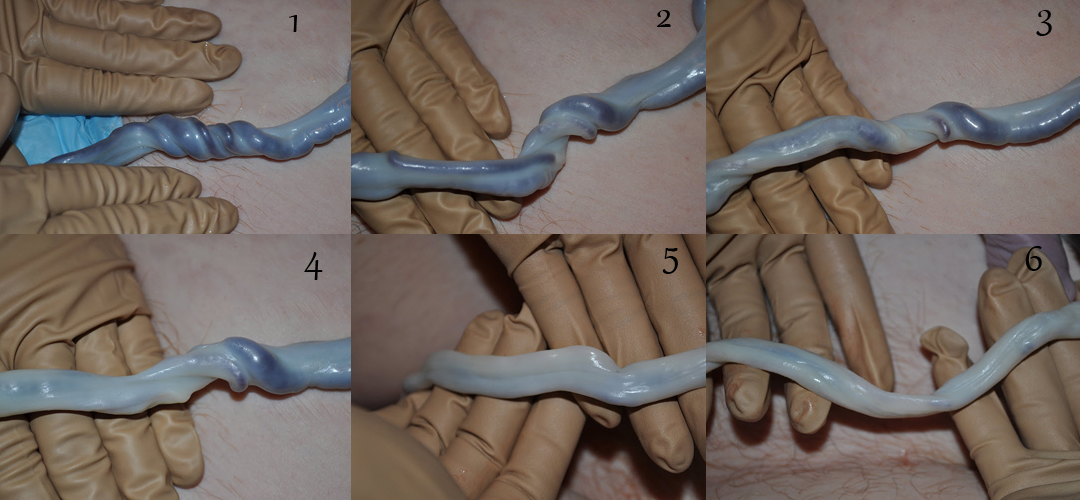
So what should the cord look like when we cut it? White, empty, and not pulsating—when you can see with the naked eye that it’s no longer doing its job.

So why does the author “blame” anesthesia for cutting the cord? When doctors began using anesthetic gas, they were only just starting to learn about the side effects it had on the mother (e.g., bleeding and liver damage). An obvious side effect was also that newborns had breathing difficulties after birth—good heart activity, but poor breathing. So they had to take measures such as suctioning and assisted ventilation. The routine at the time was to turn the baby upside down and spank them so they would spit out secretions. And to stop the baby from receiving anesthesia through the cord, the solution was to cut the cord as soon as possible. In some places this is still routine today, even though anesthesia and analgesic therapy have advanced greatly.
Doctors were concerned about the routine they had introduced, but they knew that only in this way could they save the baby’s life and reduce the effects of anesthetics.