In the Roman Empire, as throughout the ancient world, childbirth was a “women’s matter”. Female midwives, with the help of family members, brought the baby into the world and focused on caring for the newborn. Apart from a few rare records and funerary monuments, very little information about pregnancy and childbirth in ancient Rome has been preserved; most of what we know comes from the writings of male authors.

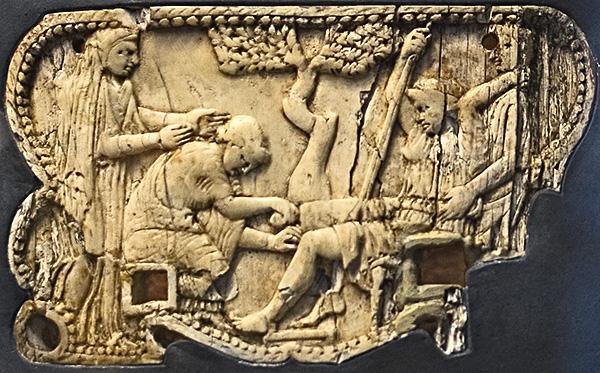
FIRST IMAGE: An ancient Roman relief shows a midwife during childbirth. Many midwives had other occupations and took on the role of leading births as their contribution to the community.
In Rome, midwives generally did not practise only this profession—those who did were more the exception—but they were still very important for women giving birth. Not only were they involved in the baby’s birth, they also provided postpartum support, cared for the woman, and provided care for the baby (French, 1986). Roman midwives were educated, free women, but men considered women to be crude and therefore the most suitable to be involved in difficult births (Todman, 2007). The midwife helped a Roman woman gain standing in a society that otherwise focused on male knowledge and power.
Soranus of Ephesus in Asia Minor (in present-day Turkey), a physician at the turn of the first and second centuries AD, in his work “Gynaecology” describes the ideal midwife, who should be:
– literate, educated in theory and practice, with a good memory and a love of the work, and familiar with hygiene procedures,
– brave and fearless during childbirth,
– calming, steady, and quiet,
– not focused on money,
– respectable and generally physically sound, with sharp senses, robust, and with strong limbs,
– in the opinion of some people, gifted with long, thin, delicate fingers and short nails.
Not all midwives in Rome were literate, as literacy was not essential for passing oral tradition from one woman to another. Some knowledge—such as contraceptives or preparations to end a pregnancy, as well as remedies to speed up a difficult labour—was shrouded in secrecy and therefore not written down (Totelin, 2017).
Midwifery in Rome – a side occupation
The fourth-century author Eunapius recounts an anecdote in which a saleswoman in a Roman wine shop, who was also trained in midwifery, was serving a customer when a neighbour called her to attend a difficult birth. After the birth, she washed her hands and immediately returned to her customers. In many cases, being a midwife was a side/additional occupation—something women saw as a contribution to the community. Those women who, like Scribonia, specialised in births and took up midwifery as a profession were the exception rather than the rule.
We can assume that childbirth in the ancient world was a far riskier process than it is today: there were few options for pain relief and little understanding of infection and basic hygiene. If labour went well, women in the Roman Empire gave birth with the help of a “wise family member” only—without major interventions, apart from massaging the genitals with warm olive oil. Breathing advice was welcome; Soranus tells us that women should “hold their breath” when the pains are at their worst (Totelin, 2017).
To speed up labour, Roman women wore amulets. Many amulets in the ancient world were made of perishable materials and few have survived, but a preserved example from Roman Egypt, now in the Kelsey Museum in Michigan, illustrates a magical formula and a womb that can be opened and closed with a key—closed when a woman wanted to avoid pregnancy or when she “locked” the womb after conception; and open when she wanted to conceive or open the womb for childbirth (Totelin, 2017).

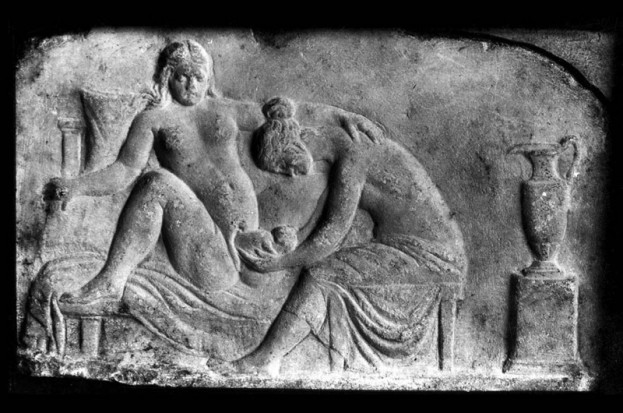
SECOND IMAGE : The funerary monument of Marcus Ulpius Amerimnus and Scribonia Attice, husband and wife, from the second century AD, from Ostia near Rome, shows Scribonia, who was a midwife. The relief depicts Scribonia attending a birth. A naked woman sits on a birthing chair (a special seat with handles that the woman in labour holds onto during birth). She is supported by a woman, perhaps a relative, while the midwife Scribonia sits on a smaller chair, ready to catch the baby; her gaze is directed away from the woman’s genitals, probably so the woman in labour would not feel embarrassed.
If the birth was somewhat more complicated—for example, if it lasted a long time or the baby was poorly positioned—midwives and doctors relied on their hands, which they could use to gently encourage the womb to open or try to turn the baby. Ancient texts do not mention episiotomies, nor do they describe the use of special medical instruments during childbirth. Although the “caesarean section” is named after Gaius Julius Caesar, Roman midwives and doctors did not perform this procedure (Totelin, 2017).
Tasks of a Roman midwife
– Caring for the baby, assessing their overall health, and identifying deformities (French, 1986).
– Advising on raising the child and presenting the baby. Ultimately, the man as head of the household decided whether the child would be raised or killed (Todman, 2007).
– Providing abortion and contraception (Riddle, 1992).
– Cutting the umbilical cord and bathing the newborn (French, 1986).
Treatment and injuries
Midwives and doctors could prescribe herbs to stimulate contractions if labour slowed. Women were also supposedly tied to ladders and shaken to speed up labour, although Soranus strongly condemned such a practice. In the worst circumstances, the life of the woman in labour took priority and an embryotomy was performed: the fetus was cut into pieces and pulled from the womb with hooks (Totelin, 2017).
Ancient authors were aware that childbirth was a major ordeal for women, which could exhaust them or even cause death. Pregnancy could cause discomfort and strange cravings—such as eating soil—and nausea, for which, as Pliny the Elder writes, they used citrus fruits (Totelin, 2017).
Pliny the Elder’s notes (Historia Naturalis) also include the following pieces of folk advice (French, 1986):
– Menstrual discharge causes infertility in seeds and destroys crops (Pliny HN 7.13).
– If a woman is carrying a male fetus, she will look healthy and the birth will be less painful (Pliny HN 7.5).
– If a woman is carrying a female fetus, she will be pale and the birth will be painful (Pliny HN 7.5).
– To have a male child, a woman must eat rooster testicles (Pliny HN 30.43).
– A woman should drink powdered pig droppings to reduce pain during childbirth (Pliny HN 28.77).
A somewhat more medical view of childbirth from Roman times is recorded in Soranus’ “Gynaecology”. With this, Soranus placed midwifery within the medical sphere, distinct from the male one (Dunn, 1995):
– Menstruation is natural for women, but women who are more active bleed less than inactive women (Soranus Gyn. 1.22).
– Despite ancient attempts to determine sex, there is no accurate way to determine a baby’s sex while the baby is still in the womb (Soranus Gyn. 1.46).
– Midwives should apply warm oil to a woman’s belly and labia during labour to provide lubrication and reduce pain (Soranus Gyn. 2.4).
– Women should give birth on a birthing chair (Banks, 1999), and later be moved to a soft bed to rest (Soranus Gyn. 2.2).
– Women should choose a wet nurse with medium-sized breasts and good habits (Soranus Gyn. 2.19).

THIRD IMAGE: A relief on a second-century sarcophagus shows breastfeeding.
Whose breast is best?
The question of whether mothers should breastfeed their children was quite prominent in ancient Rome. At the time, it was often considered that the only safe way to feed a newborn was breastfeeding. Finding animal milk (usually goat’s milk) in a large city like Rome was not always easy, and such milk could prove indigestible or even dangerous. The vast majority of babies were breastfed, even for more than 18 months. Ancient baby bottles have been found, but they were probably intended for feeding older children rather than very young babies (Totelin, 2017).
Debates about infant feeding arose among Rome’s upper classes. On one side were advocates of breastfeeding by the mother; on the other, those who, at least in some circumstances, supported breastfeeding by wet nurses. Soranus, although not opposed to a mother breastfeeding, states that breastfeeding could be tiring for the mother and that the milk of a tired and feverish mother could harm the child. A well-nourished “Greek” wet nurse under 40 would be ideal. The wet nurse was to be paid for this (Lines, 2015). However, the “perfect” wet nurse may not always have been available, and other authors record concerns about the negative influence an unsuitable wet nurse could pass into her milk and then to the child, because the Romans believed that character is passed on through breast milk. In general, Romans considered breast milk a powerful substance that could treat many illnesses, from respiratory disease and poisoning to eye problems. Ancient recipes for eye problems often recommended soaking ingredients in human milk—an ingredient that was accessible and inexpensive (Totelin, 2017).